
Paradigm-specific behavioral events
Define labels, intervals and instantaneous events for the task, then verify candidate locations and boundaries.
Intelligent mouse behavior recognition
A trained model directly predicts behavior categories, segment timing and instantaneous events from video, covering 7 scenarios and 19 behavior categories. A linked timeline supports source-video review.
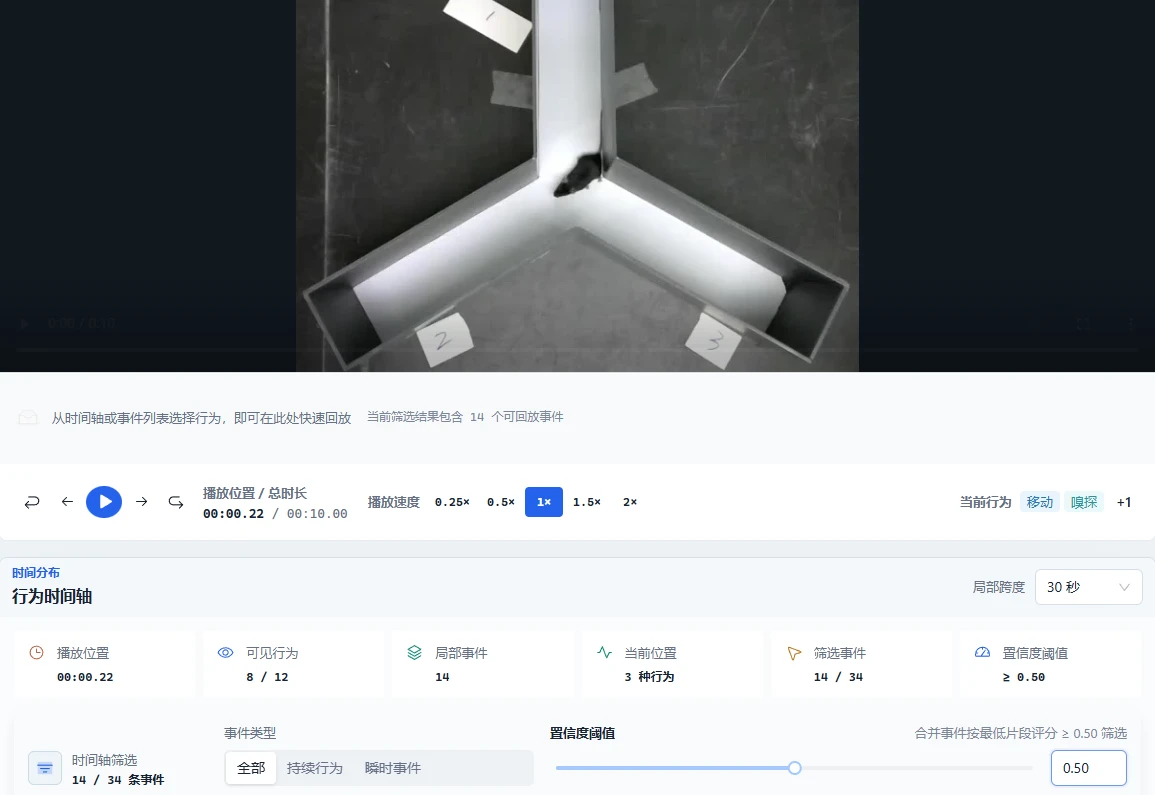 Enlarge image
RESEARCH APPLICATIONS
Define labels, intervals and instantaneous events for the task, then verify candidate locations and boundaries.
Locate candidates using timelines and filters, recording overlapping intervals and manual confirmation.
Split data by individual, distinguish negative from unannotated observations, and evaluate events and their temporal overlap.
END-TO-END VIDEO BEHAVIOR PREDICTION
Scene-specific configurations support behavioral segment and instantaneous event prediction.
Each setting uses its own label set; not every behavior applies to every setting.
CORE CAPABILITIES
Configure labels for each experimental scenario and handle sustained segments separately from instantaneous events.
Retain video timestamps and associate global scene and subject-local information to locate replayable intervals.
A temporal model combines scene, subject-local information and localization reliability to predict categories and temporal boundaries directly.
Support overlapping behavioral segments and instantaneous events with their respective timing boundaries.
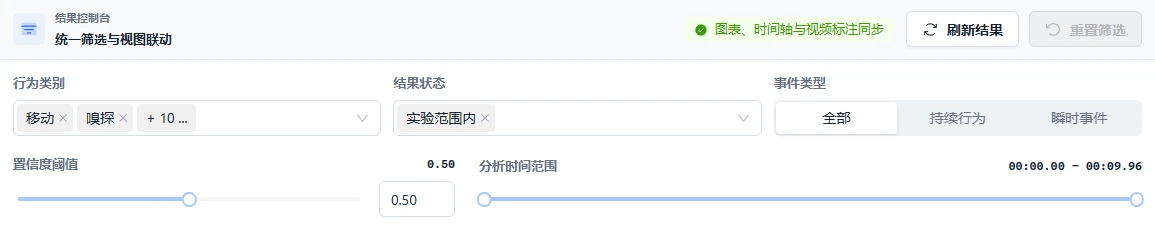
Filter candidates by category, event type and time, replay the video, and save confirmed results.
Distinguish explicit negatives from unobserved/unannotated data, split by individual, and evaluate using measures such as temporal overlap.
Actual interfaces for parameter configuration, result filtering, and review; original screenshots retain their Chinese labels.
 Enlarge image
RESEARCH OUTPUTS
Measured examples from Behavior Analytics, preserving original figures and quality information.
 Enlarge image
REPORT EXAMPLES
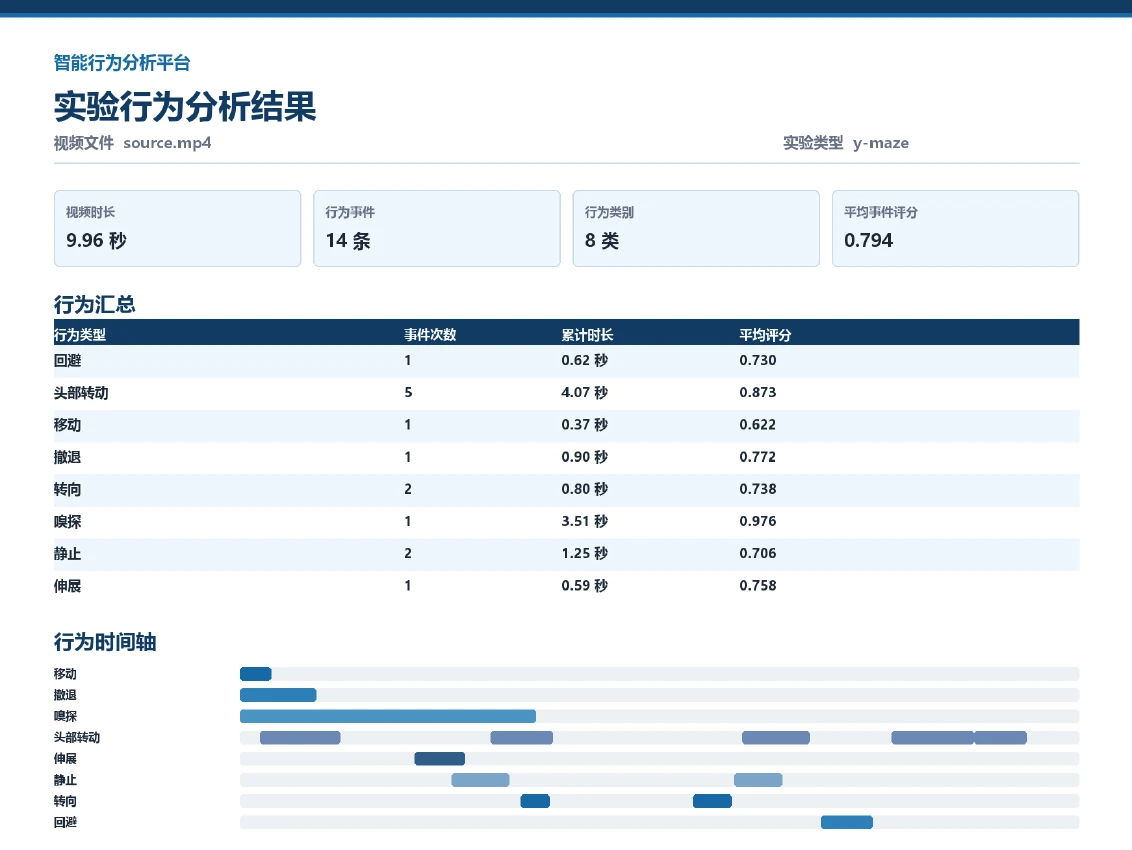
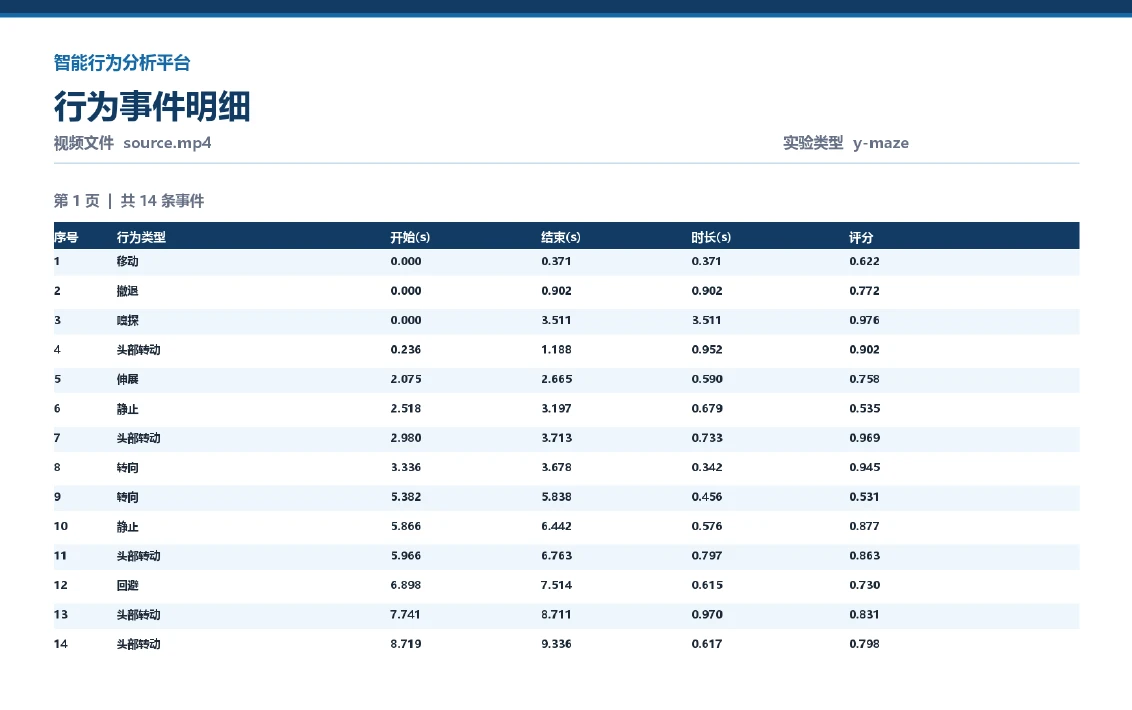
Rendered from PDFs actually exported by the software, retaining original figures, labels, and quality notes.
 Enlarge image
 Enlarge image
ANALYSIS WORKFLOW
Select the paradigm and check definitions for behavior categories, sustained intervals and instantaneous events.
Link continuous videos to task parameters and inspect source-video and subject information.
Locate behavioral segments and instantaneous-event candidates using the event timeline and filters.
Check categories, boundaries and overlaps, then save annotation and confirmation records.
Review annotation and evaluation information as required and export confirmed analysis data.
DELIVERABLES
BEFORE ANALYSIS
FREQUENTLY ASKED QUESTIONS
No. End-to-end means the model directly predicts categories and timing, rather than creating labels from trajectory rules. Research use still requires source-video review; coverage is not an accuracy guarantee.
No. Scores support ranking and filtering. Evaluate recognition against manual annotations that follow the experimental definitions, using appropriate evaluation measures.
Choose Behavior Studio for distance, speed and zone occupancy; explore Dense Tracking Studio for body-surface motion and interactions; choose Behavior Analytics for behavior categories, occurrence times and boundaries.
Tell us your experiment, recording angle, and target measurements to arrange a Behavior Analytics demo and sample assessment.